
Spring 2027
Scroll down this page to take a look at the various HON course options.
HON 2081.H01 Honors Forum III
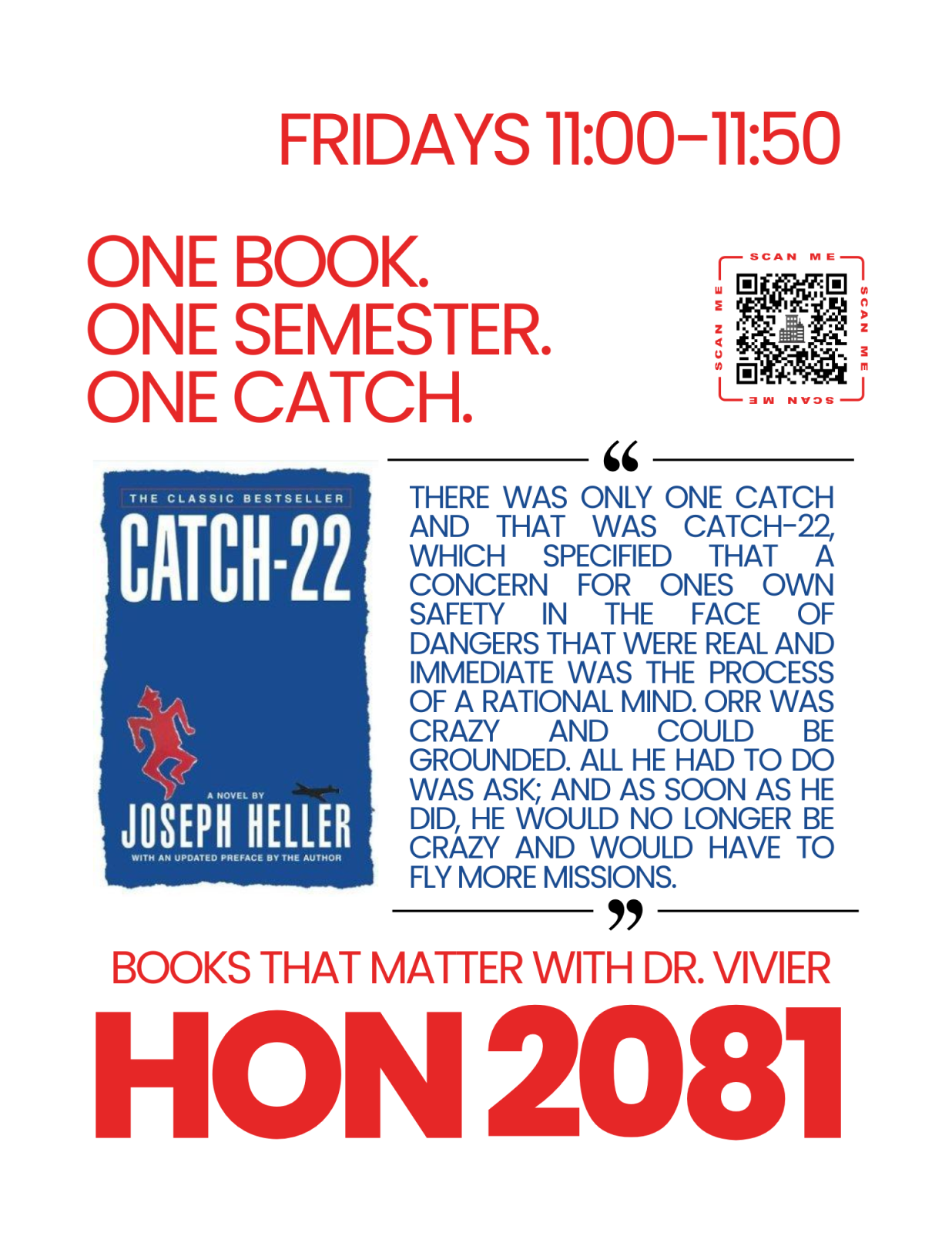
Books that Matter: Catch-22
F 11:00 AM – 11:50 AM
Taught by Dr. Eric Vivier, Faculty Fellow, Shackouls Honors College, Professor of English
Some books are defined by a before and after - we are different people after reading the final sentence than we were when we began the journey. Books That Matter is a one-credit-hour seminar centered on a single essential text: a complex, influential book that has left an lasting mark on the way we understand our world.
Through Socratic inquiry, students will read closely, ask questions, and engage in thoughtful discussion about the book’s ideas, historical context, and lasting significance. The course provides a space to critically examine how a single work can shape the way we think, challenge our assumptions, and continue to influence readers beyond its original moment. Books That Matter invites students to find meaning, inspiration, and pleasure in a book that has the power to stay with them long after they have finished reading it.
"There was only one catch, and that was Catch-22, which specified that a concern for one's own safety in the face of dangers that were real and immediate was the process of a rational mind. Orr was crazy and could be grounded. All he had to do was ask; and as soon as he did, he would no longer be crazy and would have to fly more missions."
HON 2091.H01 Honors Forum IV
Preparing and Applying for National Fellowships
M 4:00 PM – 4:50 PM
Taught by Dr. David Hoffman, Director of the Office of Prestigious External Scholarships and Professor of Anthropology
What is a national fellowship? Why should I care? I want to be a doctor, so the Rhodes Scholarship is not for me? There is no way I can win a national fellowship like the Gates Cambridge. I’m too busy to write yet another personal statement for a fellowship. All those fellowships go to Ivy League kids. They won’t respect MSU and Mississippi, so why bother? My advisor thinks I should just go on to graduate school. I’m a STEM student, and all of those fellowships go to English or history majors. This seminar course teaches students about many of the most prominent scholarships and fellowships for undergraduates as they plan for a future in graduate school, learning a second language, or creating change in the world around them. Students learn how to amplify their college experience and make themselves better applicants for not only scholarships but also graduate school, professional school, and employment. Students will learn the requirements of scholarships such as the Rhodes, Truman, Fulbright, Goldwater and many others. The class gives insight into what opportunities to seek out to make them better candidates for scholarships, engage with former MSU winners and finalists to learn from their stories, and workshop and develop professional materials for scholarship applications.
HON 3143.H03/D01 Honors Interdisciplinary Seminar in Social Sciences
Technology and the Human Future
MW 8:00 AM – 9:15 AM
Taught by Dr. Jonathan Barlow, Professor of Data Science
This is a 3-credit-hour, college-level seminar course focusing on works of nonfiction that engage the primary drivers of technology in the coming decade, including biotechnology, nanotechnology, and artificial intelligence. Students will ground social, ethical, and existential considerations of humanity’s technological future in critical readings from the pioneers of these technologies.
HON 3143.H02 Honors Interdisciplinary Seminar in Social Sciences
Legislating in a Democratic Society
MW 12:30 PM – 1:45 PM
Taught by Dr. Brian Pugh, Executive Director of the Stennis Center for Public Service
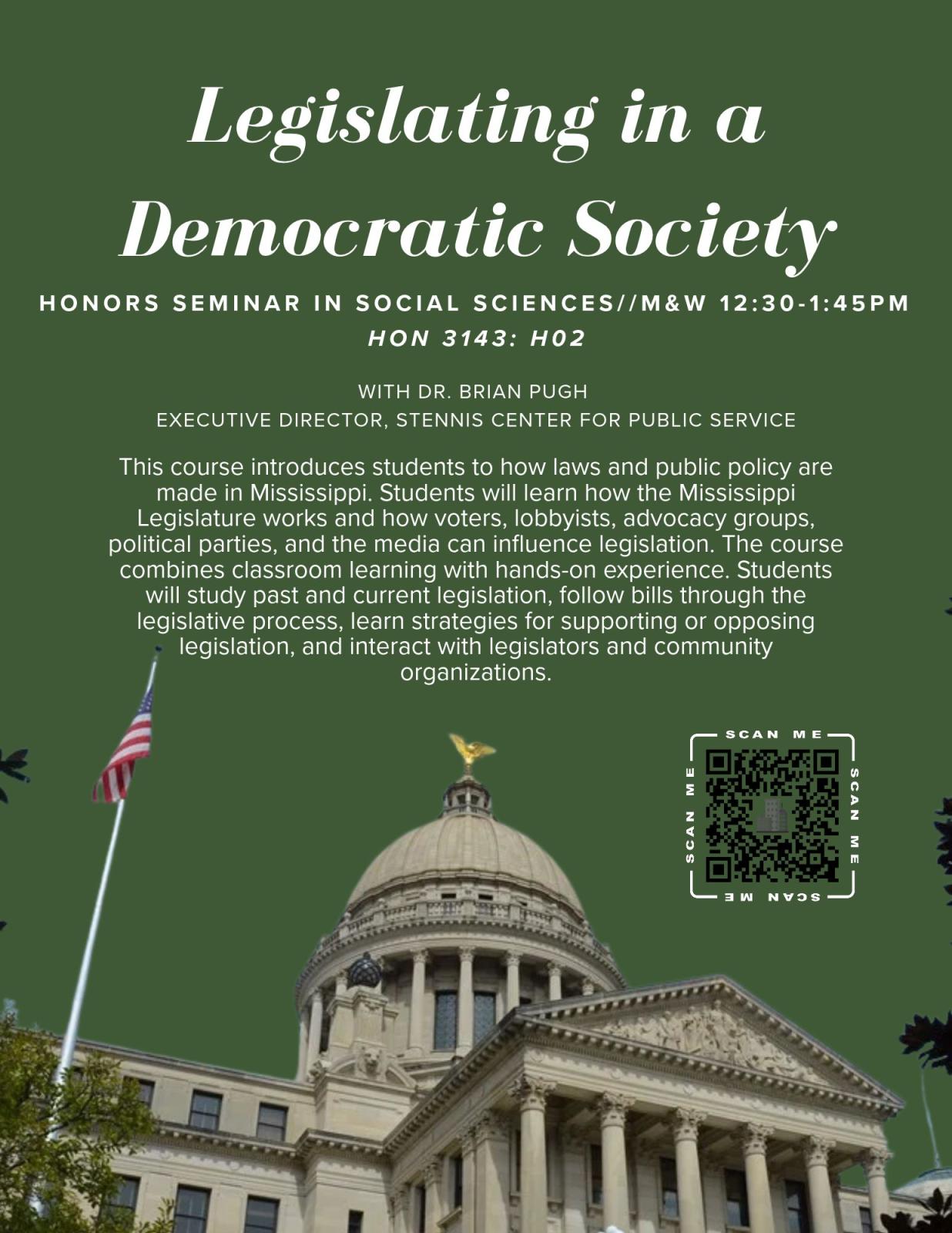
In a democratic society, laws should reflect and protect widely shared views of the public good, yet there is often deep disagreement about what that good is and how to achieve it. Affordable housing, environmental protection, and gun ownership are just a few of the issues that have sparked fierce debate. Media attention to such controversies tends to focus on the national level, but state legislative action is often both a more direct force in citizens’ lives and a powerful influence on national policy. This course introduces students to the lawmaking process in Mississippi through direct engagement with the state legislature and policy advocacy—the range of actions used to advance one’s preferred policy responses to social problems. Students will learn and practice strategies for policy advocacy, and examine how advocacy shapes whose values and interests become law.
This is a “hands-on” course that begins by examining past legislative actions still affecting Mississippi today, both positively and negatively. Students will also carry out an applied advocacy project, working in teams to follow bills through the legislative process and develop a step-by-step plan to help pass or defeat them. Along the way, they will learn to research and frame issues to build support across interest and ideological divides, build relationships with legislators and stakeholders, and express policy positions orally and in writing. The course features guest lecturers, meetings with community organizations, and a trip to the state capitol to meet with legislators.
This course will help students recognize the gap between the actual legislative process and its popular or theoretical descriptions, distinguish political pressure rooted in special interests from legitimate concerns about a policy’s practical implications, and weigh the relative roles of ideology, evidence, and citizen advocacy in shaping policy. By combining social science theory with practical application, the course equips students with proven tools for legislative analysis.
Your work in Honors Seminar in Social Sciences – Legislating in a Democratic Society is part of a larger initiative to engage undergraduate students with the state legislative process. Brandeis University’s Educational Network for Active Civic Transformation (ENACT) Program provides an online network for students across the country to connect on legislative issues. To access resources and connect with change makers in other states, visit www.enactnetwork.org.
HON 3143.H04 Honors Interdisciplinary Seminar in Social Sciences
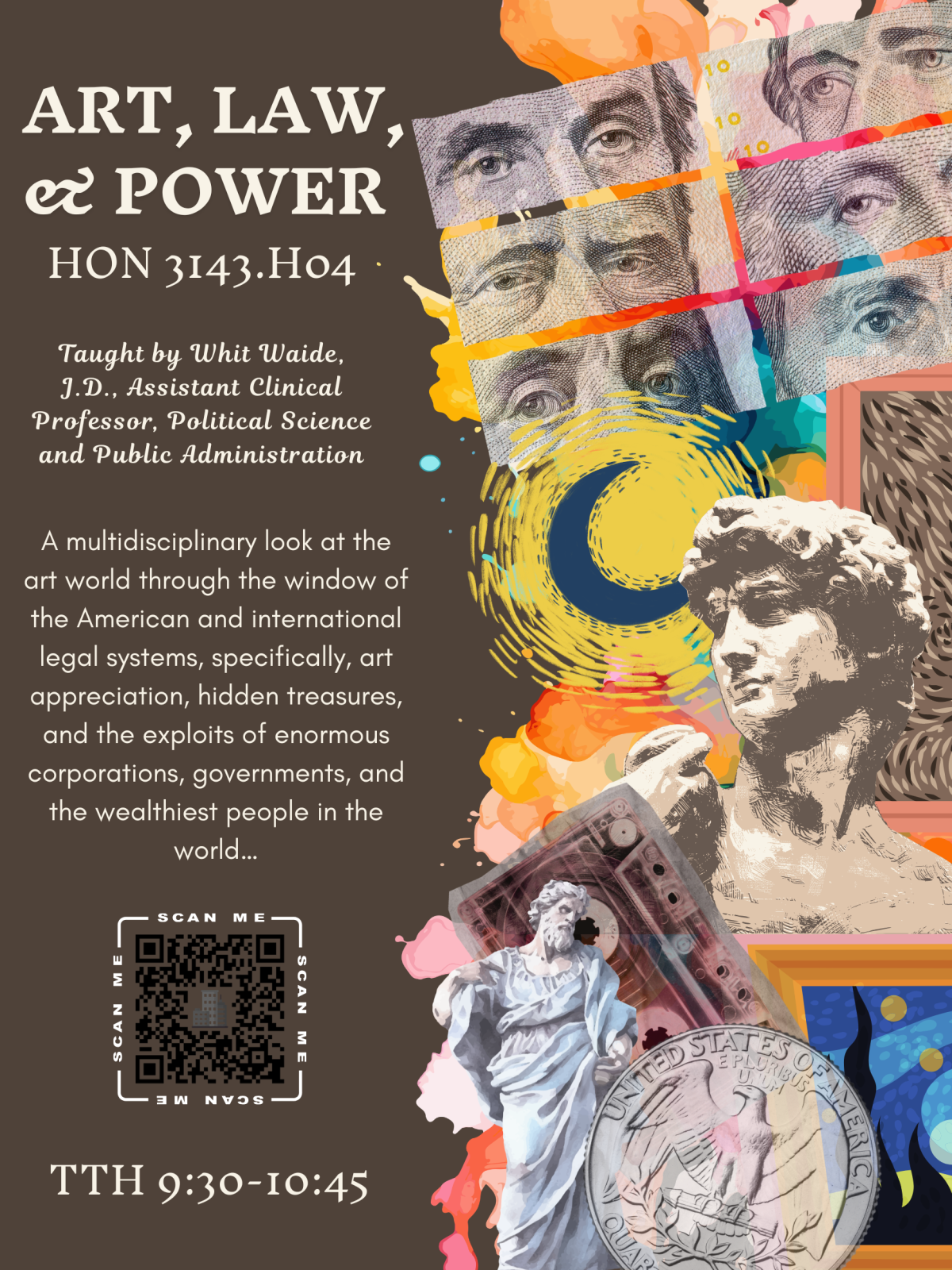
Art, Power, and Law
TR 9:30 AM- 10:45 AM
This course is a multidisciplinary look at the art world through the window of the American and international legal systems. It is also a course about art appreciation, hidden treasures, and the exploits of enormous corporations, governments, and the wealthiest people in the world. The course will cover a wide range of legal issues in the international art market and certain issues involving music and musicians as well. Topics will include recent litigation involving looted artworks during wartime; international preservation efforts in stolen cultural property and antiquities; art crimes including theft and money laundering; copyright and trademark protections for artists; legal issues in artists’ estates and foundations; government funding and art; and the First Amendment and censorship issues. The course will provide insight into the lives of the artists and artwork involved in the litigation. Assignments will include reading actual court cases involving artworks, as well as academic journal articles and documentaries about the artists themselves, their work, and art history.
HON 3163.H01 Honors Interdisciplinary Seminar in Natural Sciences
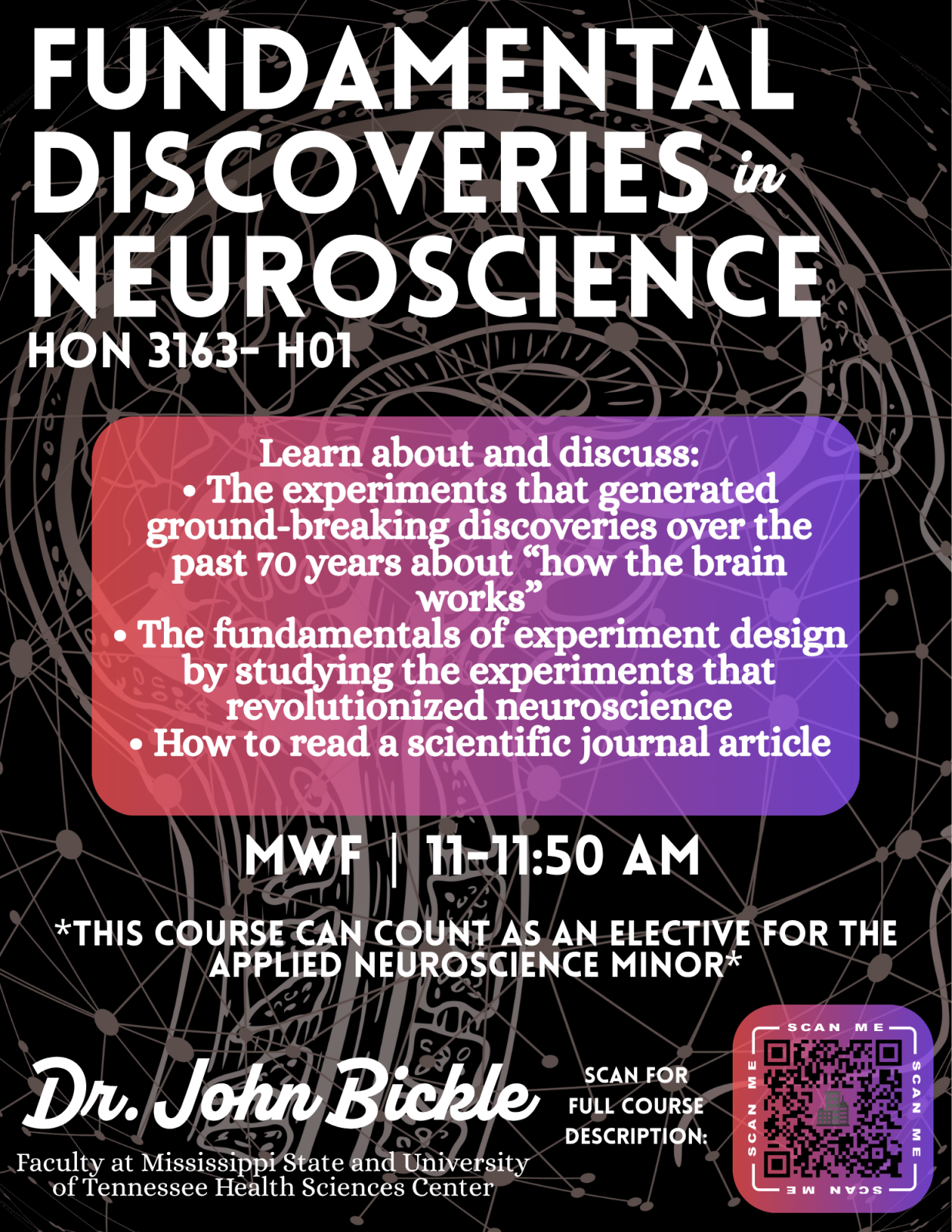
Fundamental Discoveries in Neuroscience
MWF 11:00 AM – 11:50 AM
Taught by Dr. John Bickle, faculty member of both Mississippi State University and UTHSC (University of Tennessee Health Science Center), Honorary Fellow of the American Association for the Advancement of Science (AAAS)
Learn about and discuss:
- The experiments that generated ground-breaking discoveries over the past 70 years about “how the brain works”
- The fundamentals of experiment design by studying the experiments that revolutionized neuroscience
- How to read a scientific journal article
This course will be taught “journal club” style: for each meeting we’ll read a scientific publication from neuroscience’s history and discuss the “hows and whys” of the experiments, the results, and their significance for the field. Students will write clarification and evaluative questions for each paper, participate in seminar discussions, and write a research paper based on a recent publication in a neuroscientific journal that interests him or her.
Benefits of taking this seminar:
- Learn not only what we know about how the brain works, but how we came to know all this.
- Improve one’s grasp of general principles of experiment design •Learn about some of the research tools and techniques that have defined laboratory neuroscience
- Leave with the kind of experience that many science students don’t acquire until graduate school
HON 3173.H01 Honors Seminar in Fine Arts
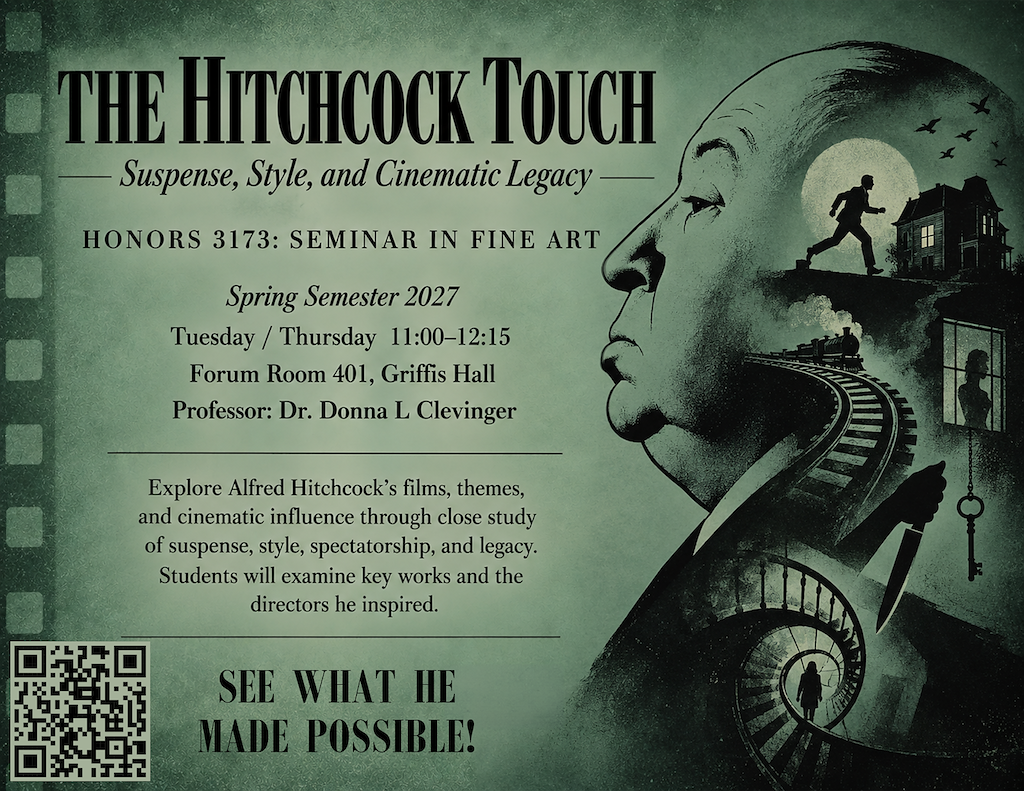
THE HITCHCOCK TOUCH: Suspense, Style, and the Cinematic Legacy
TR 11:00 AM-12:15PM
14 maximum seats available, sophomore standing and above.
Taught by Dr. Donna Clevinger, Senior Faculty Fellow, Shackouls Honors College
As one of the most influential directors of the 20th century, Alfred Hitchcock reshaped the language of cinema --- from the grammar of suspense to the psychology of looking and from the architecture of thrillers to the emotional logic of obsession. This course explores seven of Hitchcock’s landmark films and traces his artistic DNA across generations of filmmakers including David Lynch, Martin Scorsese, Brian De Palma, Jordan Peele, Kathryn Bigelow, and the Coen Brothers. Students will examine Hitchcock’s visual style, narrative experimentation, and thematic obsessions of voyeurism, identity, gender, power, and cultural impact by engaging in the art of storytelling, intentional readings, film theory, and comparative analysis. Through screenings, discussions, scene exercises, critical writing, and creative projects and presentations, students will learn how Hitchcock changed the way we watch --- and how his legacy continues to shape ---the modern cinema.
HON 3183.H01 Honors Interdisciplinary Seminar in Humanities
Minds, Machines and Morality: Ethics in the AI Era
TR 2:00 PM – 3:15PM
Taught by Dr. Danielle Wylie, Faculty Fellow, Shackouls Honors College, Professor of Philosophy
Although philosophers of mind have seriously discussed the possibility of artificial intelligence for nearly a century, AI has become a prominent part of everyday life at what sometimes seems like a shockingly fast pace. A number of moral and philosophical questions have arisen as a result, concerning privacy, bias and fairness, misinformation, labor, environmental impact, and more. This small discussion-based seminar will examine these questions using philosophical readings and contemporary case studies.
HON 3183.H02 Honors Interdisciplinary Seminar in Humanities
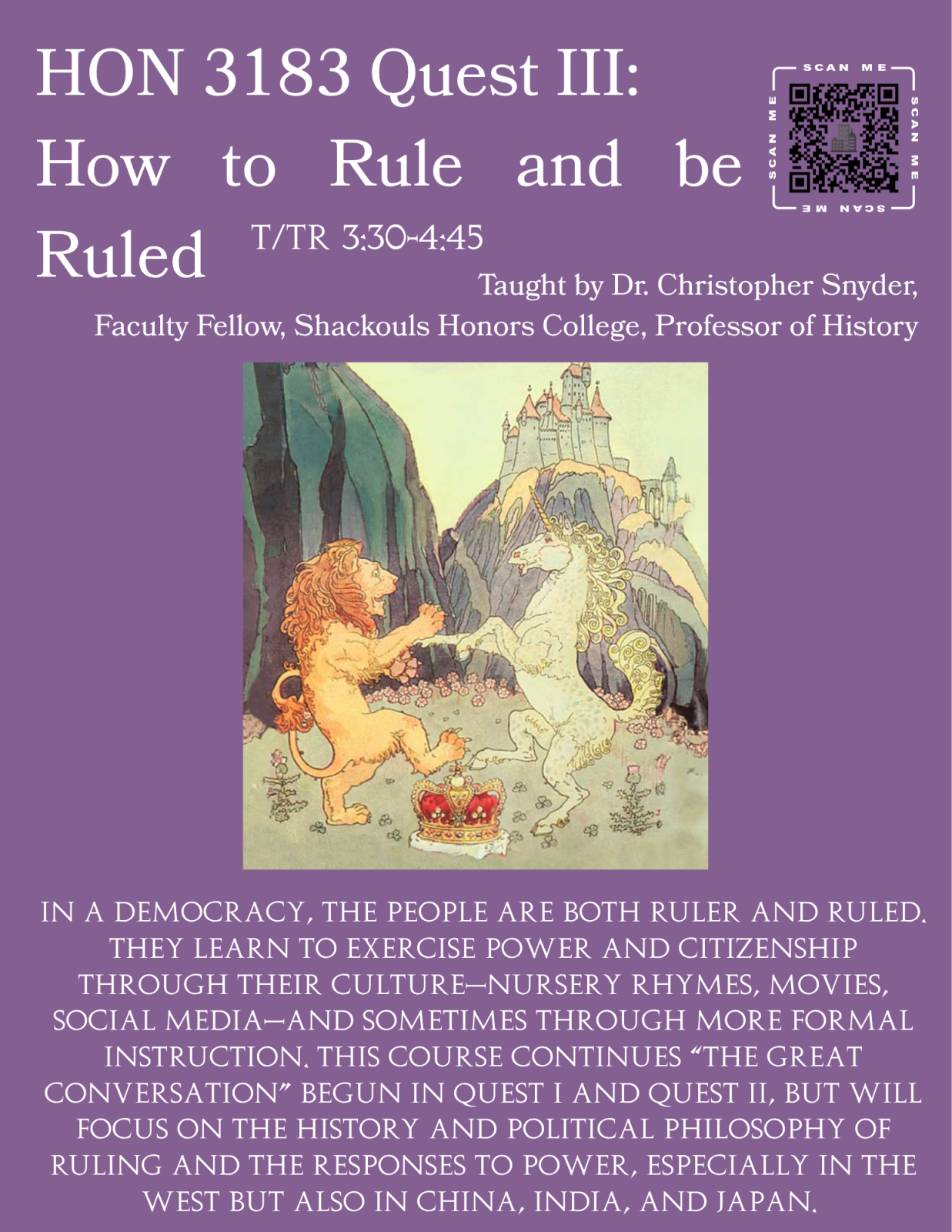
Quest 3: How to Rule and Be Ruled
TR 3:30-4:45PM
Taught by Dr. Christopher Snyder, Faculty Fellow, Shackouls Honors College, Professor of History
In a democracy, the people are both ruler and ruled. They learn to exercise power and citizenship through their culture—nursery rhymes, movies, social media—and sometimes through more formal instruction. This course continues “the Great Conversation” begun in Quest I and Quest II but will focus on the history and political philosophy of ruling and the responses to power, especially in the west but also in China, India, and Japan. We will read and discuss works by Plato, Aristotle, Thucydides, Confucius, Seneca, Tacitus, Augustine, Aquinas, Machiavelli, and more contemporary novels as well as fantasy and science fiction films.
EN 2904.H02 Introduction to Film: An Honors Class for Filmmakers & Movie Lovers
MW: 12:30 - 1:45PM; T 3:30-5:50PM
Taught by Dr. Andrea Spain, Associate Professor, Department of English
We will ask questions like: How did director Spike Lee become an auteur, and how did he change cinema? Why is the "The Wizard of OZ" one of the greatest films ever made? Is Tarantino's Django Unchained a masterpiece or an obscenity? We will ask: How do all films affect us on a bodily level, leaving us laughing, crying, leaping out our seats or awed with wonder?
Students can complete the class with a final research paper or choose instead to team up and write, direct, edit, and present their own film.
